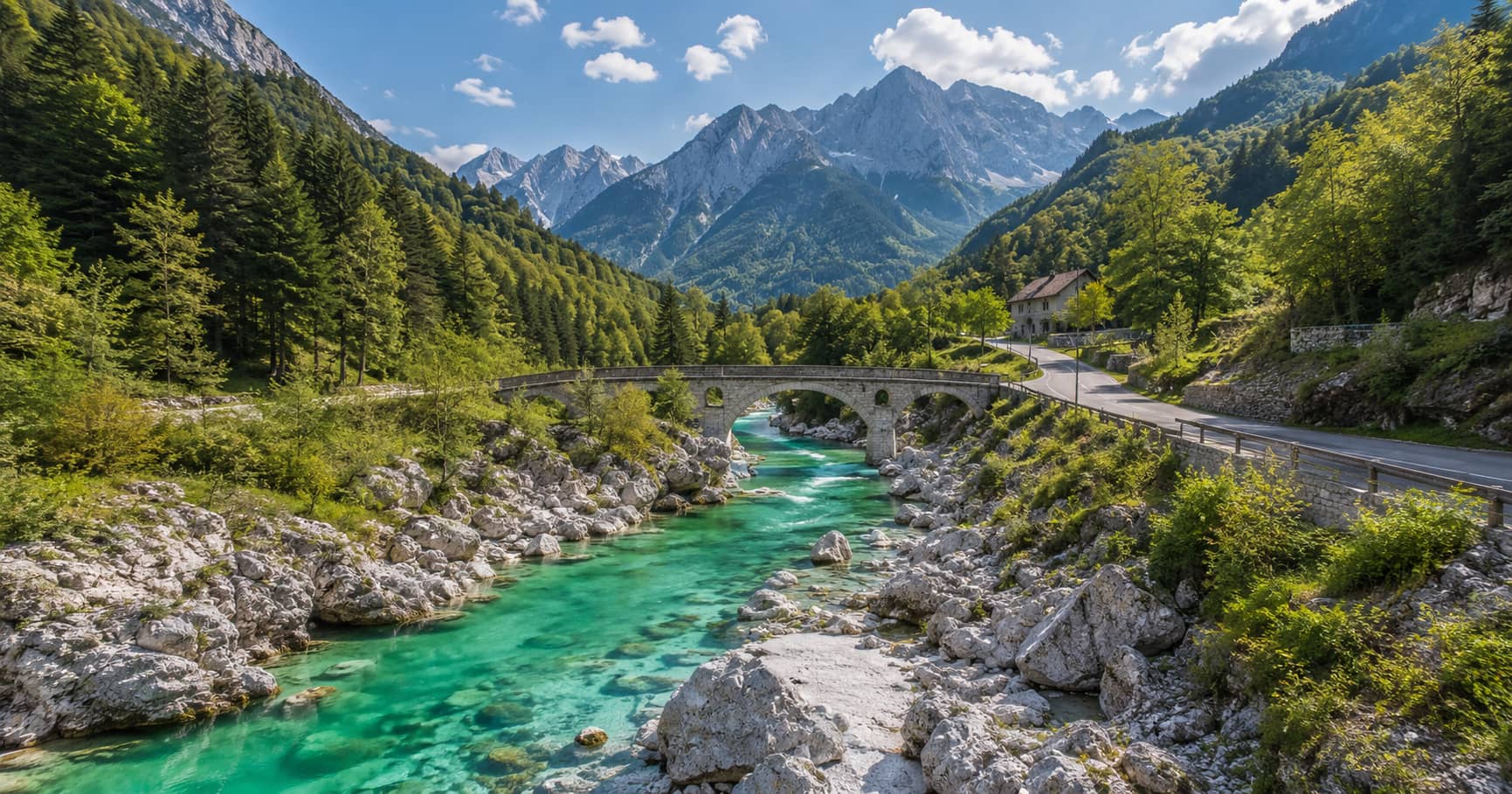
Soča Valley Scenic Stops
A route through Slovenia’s Soča Valley featuring emerald river views, gorges, bridges, mountain backdrops, short walks, and practical roadside access.
A route through Slovenia’s Soča Valley featuring emerald river views, gorges, bridges, mountain backdrops, short walks, and practical roadside access.
The Soča Valley is known for turquoise water, but a useful road trip should show more than one river colour from repeated bridges. The valley changes from high Alpine terrain near Trenta to broad bends, gorges, waterfalls, meadows, and the lower hills around Tolmin. The best route selects stops that explain those changes while keeping parking, walking time, and seasonal daylight realistic.
October brings cooler temperatures and autumn colour, but it also brings shorter days, wet leaves, and less predictable river conditions. Begin early, check local weather and road information, and treat every waterfall or gorge as a walk rather than a roadside photograph.
A north-to-south route from the Vršič area through Trenta, Bovec, Kobarid, and Tolmin follows the river downstream. This gives the route a clear progression, but mountain access may be affected by weather. A south-to-north route works better if you start near Tolmin or arrive from Nova Gorica.
Do not attempt every attraction in one day. The road is scenic, yet frequent stopping, narrow sections, and short walks make progress slow. A balanced day needs one high-valley stop, one gorge or waterfall, one open river view, and one final elevated or cultural viewpoint.
In the upper valley, the Soča is smaller and surrounded by steep peaks, forests, and glacial terrain. Use safe pull-offs and marked paths rather than stopping on narrow road edges. The river’s colour may appear less intense in shade, but the mountain context is the main reason to begin here.
Short sections near established access points are more useful than trying to follow every bend. Morning cloud can sit low in the valley, while gaps may create dramatic layers. If visibility is poor, focus on forest, water texture, and closer scenes instead of waiting indefinitely for the peaks.
The Great Soča Gorge shows the river compressed into narrow rock channels. It is visually different from the broad turquoise pools farther downstream, but it also requires caution. Paths and edges can be slippery, and water levels change the appearance and risk.
Stay on established routes and do not approach exposed edges for a cleaner angle. The gorge is strongest when photographed as a sequence of water, rock, and forest, not as a single wide panorama. Overcast light can be useful because it reduces harsh reflections and keeps detail in the channel.
Bovec sits in a broad basin and works well for food, fuel, accommodation, and route decisions. The town itself is not the only visual objective. Use it to choose between a western detour toward waterfalls, a river stop, or a direct continuation toward Kobarid.
If weather is deteriorating, shorten the plan here. A flexible road trip is better than reaching a gorge after dark. The official Soča Valley tourism site provides current destination information and is the right place to check local access before leaving the main road.
Kozjak Waterfall lies in a dark rock chamber reached by a walking route near Kobarid. The official destination page describes the waterfall as a protected natural attraction and provides practical visitor information. Review the official Kozjak Waterfall guidance before setting out.
Allow time for the approach and for slower movement on damp surfaces. The enclosed setting often has a wide brightness range, so expose for the waterfall and avoid forcing a bright sky into the frame. Respect barriers and viewing areas; erosion and crowd pressure make shortcuts damaging as well as unsafe.
Near Kobarid, Napoleon Bridge provides a recognizable crossing above the river and links naturally with the Kozjak walk. It can be busy and is part of local traffic, so do not stand in the road or block pedestrian movement. Use the bridge as context, then seek a permitted angle that includes the gorge and surrounding slopes.
Tolmin Gorges form the lowest and one of the most accessible entrances to Triglav National Park. The official site explains that the circular route includes steep sections and stairs, and that conditions and opening arrangements can vary. Check the official Tolmin Gorges information before arrival.
The gorges provide a different visual ending from the open river: narrow channels, rock walls, bridges, and shaded water. In October, leaves can add colour, but wet steps require more care. Start early enough to complete the marked route in daylight and never assume a short distance means a quick visit.
After enclosed gorges and forest, choose a safe, established riverside area where the valley opens. The objective is to show the Soča as a broad valley scene rather than collect another close-up of turquoise water. Look for a bend with gravel banks, trees, and mountain layers, but respect signs, private land, and river hazards.
Polarizing filters can reduce glare, yet overuse may remove natural reflections and create uneven skies. Photograph the scene as it appears. River colour changes with light, depth, sediment, and weather; do not expect every stop to match heavily edited images.
Daylight shortens quickly, mountain weather can change, and some seasonal services may operate differently than in summer. Carry a warm layer and rain protection even when the forecast appears stable. Download maps before entering areas with weaker reception, and leave room for slow vehicles and road works.
This road trip fits naturally after the Julian Alps scenic road trip, but it should not be treated as an extra loop squeezed into the same day. The upper Soča Valley deserves its own pace, especially when autumn conditions reduce daylight.
A strong Soča Valley day moves from mountain context to narrow gorge, from forest waterfall to open river, and finally to another enclosed setting or elevated view. That change tells the valley’s story better than stopping at every bridge.
Choose fewer locations, follow official access, and accept that weather changes the water’s appearance. The Soča remains visually valuable even when it is not bright turquoise. Rock, forest, mist, autumn colour, and the scale of the valley are equally important parts of the route.