Porto Scenic Walking Route
A photo-focused walking route through Porto connecting hillside streets, bridges, riverbanks, tiled buildings, and views across the Douro.
A photo-focused walking route through Porto connecting hillside streets, bridges, riverbanks, tiled buildings, and views across the Douro.
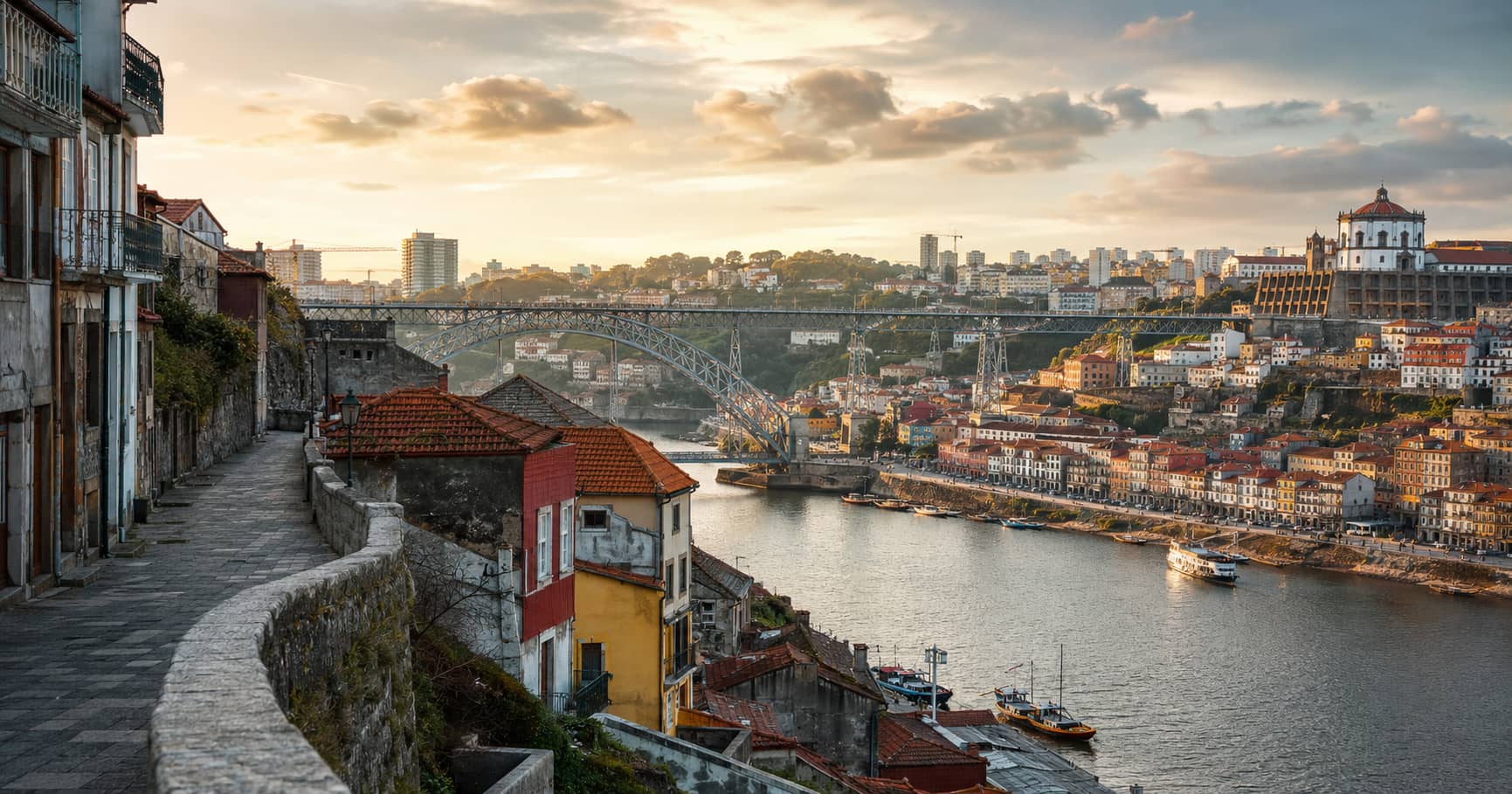
Porto’s best views come from movement. The city rises sharply from the Douro, so the relationship between tiled streets, bridges, church towers, warehouses, and the river changes every few minutes. A useful walking route should take advantage of that topography without forcing you to climb the same hill repeatedly.
Late September usually offers enough daylight for a long walk without the strongest summer heat. Rain is still possible, polished stone can become slippery, and steep lanes demand more time than a flat map suggests. This route begins high, descends through the historic center, crosses the river, and ends with a broad view back toward Porto.
The terrace around Porto Cathedral gives an immediate overview of the old city, the Douro corridor, and Vila Nova de Gaia. It is a practical starting point because you begin above the river and can spend most of the next section walking downhill.
Use the viewpoint to identify the Dom Luís I Bridge and Gaia hillside. The foreground of roofs and narrow streets is as important as the distant river. Early in the day, the terrace is easier to read and photograph before tour groups fill the main edges.
From the cathedral, descend through the lanes toward São Bento and the Ribeira. Avoid choosing only the shortest navigation line. Streets such as Rua das Flores and smaller connecting alleys provide framed views, tiled façades, laundry, balconies, and sudden glimpses of the opposite bank.
These are not panoramic viewpoints, but they give scale and context to the later river scenes. Pause where a street naturally opens rather than blocking narrow pavements. Morning and afternoon delivery traffic can make some lanes less calm than photographs suggest.
A direct descent reaches the river quickly but misses the changing relationship between upper and lower Porto. Add short lateral sections when they reveal a church tower, a slice of bridge, or a stronger street axis. Skip detours that produce the same roof view you already saw from the cathedral.
The Ribeira waterfront is one of Porto’s busiest areas. It gives a low view across the Douro toward the port lodges of Gaia and an upward view to the bridge. The scene is visually rich, but seating, restaurant terraces, boats, and pedestrian traffic make it difficult to treat as a quiet photo location.
Walk a short section along the water and use arches, boats, and façades as foreground. Then move on. The purpose of Ribeira in this route is to shift from the high historic center to the river level before crossing to Gaia.
The bridge has upper and lower crossings, and they serve different purposes. The lower deck connects the two waterfronts with a close relationship to the river. The upper deck provides the broad city panorama but involves more elevation and exposure.
For the cleanest route, cross the lower level after Ribeira, explore Gaia, then climb toward the upper viewpoints. This avoids descending to the river twice. If heights are uncomfortable or wind is strong, remain on the lower route and use the Gaia waterfront for views back to Porto.
Once across the river, turn around. The north bank rises in layers: waterfront houses, church towers, the cathedral, and denser neighborhoods behind. Walk west along the Gaia promenade for changing angles rather than stopping at the first open space.
Traditional boats can provide foreground, but do not let them hide the shape of the hillside. A slightly longer lens can simplify the stacked façades. Late-day light often reaches the Porto side well, although cloud and seasonal sun position change the result.
Jardim do Morro sits above Gaia near the upper bridge deck and is one of the most accessible elevated views in the area. The official Porto tourism listing describes it as a garden with a panoramic view of the Douro and city. Check the official Jardim do Morro information for current access and transport context.
The lawn becomes busy around sunset. Arrive early enough to choose a position without standing in circulation paths. The strongest composition may be slightly away from the central crowd, where trees or the bridge frame the city. Watch the scene after sunset as street and bridge lights begin to balance with the sky.
From Jardim do Morro, you can continue upward toward Serra do Pilar for a higher angle, subject to current access. Alternatively, cross the upper bridge deck back toward the cathedral. The upper crossing gives one of the route’s most open views, but wind, trams, cyclists, and pedestrians require attention.
Do not add a distant viewpoint merely to increase the count. Porto’s value comes from seeing the same river corridor at cathedral, street, waterfront, bridge, and hillside levels. That sequence already creates enough visual change.
Wear shoes with grip. Granite pavements and stone steps can become slick in rain, and steep streets place more strain on knees during descents than their length suggests. Carry water, but keep the bag light. Public transport can shorten the final climb if weather or fatigue changes the plan.
This route follows the same principle as the Barcelona sunset viewpoint guide: choose one coherent visual story and place the strongest panorama near the end. Chasing unrelated viewpoints across the city would add transport without improving the experience.
Start at Sé for orientation, descend through the historic streets, use Ribeira as the low point, cross to Gaia, and finish above the river at Jardim do Morro. The route is simple because gravity and the Douro do most of the planning.
Porto does not require a long list of towers or paid terraces. Its strongest views come from understanding height, crossing the river once, and looking back at the city from the opposite bank. Walk slowly enough to notice how each level changes the scene, and stop when the light gives you a reason rather than when a map tells you to.