Rhine Valley Castle Viewpoints
A scenic guide to Rhine Valley viewpoints featuring castles, vineyards, river bends, hillside paths, and practical stops along the route.
A scenic guide to Rhine Valley viewpoints featuring castles, vineyards, river bends, hillside paths, and practical stops along the route.
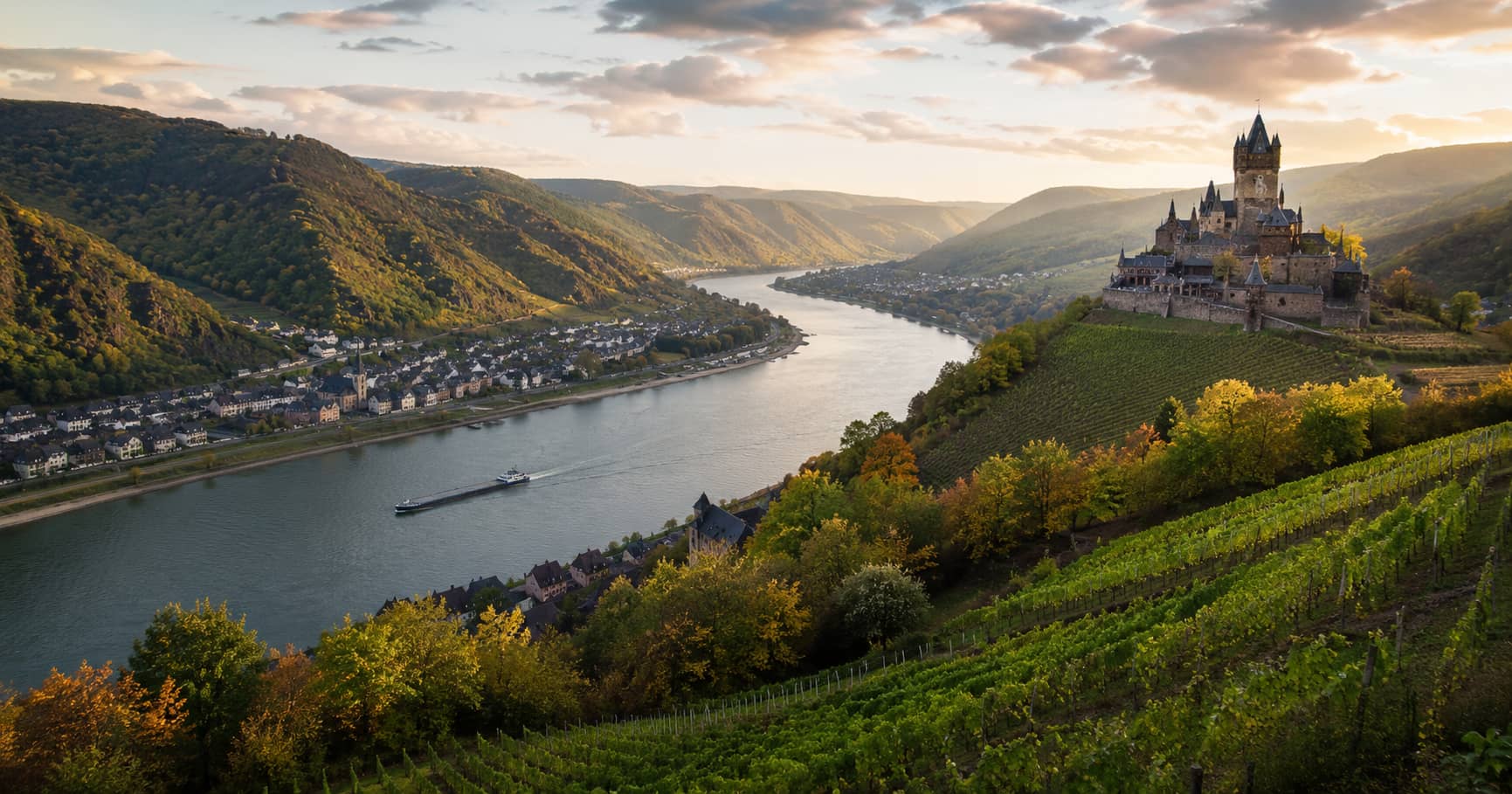
The Upper Middle Rhine Valley is visually rewarding because the terrain is easy to read: a narrow river, steep vineyard slopes, compact towns, railway lines, and castles placed above strategic bends. The challenge is not finding a famous landmark. It is choosing viewpoints that show how these elements relate to one another without spending the day crossing the river or climbing every hill.
September is a useful time for this route. The light is softer than in midsummer, vineyards begin to change, and daylight still allows several stops. Weather can turn quickly along exposed slopes, so treat the route as a sequence of flexible viewpoints rather than a fixed checklist.
The Rhine looks narrow on a map, but bridges are limited in the central section and ferries determine how efficiently you move between banks. A plan that alternates sides after every castle creates unnecessary waiting and driving. Choose a primary bank for the day, then add one ferry crossing only when it improves the route.
The left bank works well for Bingen, Bacharach, Oberwesel, and views toward the Loreley area. The right bank gives access to Rüdesheim, Assmannshausen, Kaub, and several elevated paths. Trains serve many riverside towns, which makes a one-way walk or car-free itinerary possible, but hilltop viewpoints often require an additional climb.
Near Bingen, the river narrows as it enters the gorge. The Mäuseturm stands on an island, Ehrenfels Castle sits above the opposite bank, and vineyards rise behind both. This is a strong opening view because it explains the geography before the route becomes more enclosed.
Use the riverside for a low perspective, then move to an elevated point if time and visibility allow. Morning can be useful when the river is calm, while later light may define the vineyard terraces more clearly. Avoid treating the island tower as the only subject; the wider composition is what makes this entrance memorable.
Bacharach is one of the easiest towns in which to combine medieval streets with an elevated river view. Paths above the town reveal the church ruins, slate roofs, vineyards, and Rhine in one frame. The climb is more valuable than adding several similar street-level stops along the waterfront.
Walk slowly through the town first so you understand the roofline and landmarks. On the ascent, turn back at several points rather than waiting for one official platform. The best angle may come from a permitted path where the town, river, and hills remain balanced. Wet slate and fallen leaves can make autumn paths slippery, so footwear matters even on a short walk.
Oberwesel has a long surviving town wall, towers, churches, vineyards, and Schönburg above the river. Its visual value comes from layers rather than one isolated castle. A route along permitted sections of the wall and nearby slopes helps show the settlement’s shape.
Do not spend the entire visit pointing uphill toward Schönburg. Look back toward the river and along the wall, where towers repeat through the view. A medium focal length often works better than a very wide lens because it compresses the town and vineyard slopes into a clearer pattern.
The Loreley is famous, but the rock itself is not always the most informative viewpoint. The river bend becomes easier to understand from a position that looks across or along the gorge. The official Romantic Rhine tourism site describes the Maria Ruh viewpoint near Urbar as a view toward the Loreley with the Rhine and Katz Castle in the wider scene. Check the official Maria Ruh viewpoint information before visiting.
This is a place where haze can either simplify or flatten the distant layers. Clear weather reveals distant slopes, while light mist separates the layers. Heavy rain or low cloud removes the reason for the climb, so keep a riverside town as a backup.
Railways run along both banks and are part of the working valley. Trains may enter a photograph or interrupt quiet moments. Rather than expecting an untouched natural scene, use the transport lines as evidence of how tightly infrastructure fits between river and slope. Wait for a cleaner frame when needed, but do not build the entire day around eliminating every modern element.
Kaub offers one of the valley’s clearest combinations: Pfalzgrafenstein Castle on an island, Gutenfels Castle above the town, and steep vineyards behind. The lower riverbank gives a direct relationship between the island fortress and passing boats. Higher paths add the bend and opposite slopes.
Late-afternoon light can be attractive, but the best side depends on the season and cloud cover. Scout the riverbank first, then decide whether the climb will add enough information. If the sky is dull, tighter compositions of the island castle, water, and boats may work better than a broad panorama.
A balanced day needs only three types of stop: an entrance panorama near Bingen or Rüdesheim, a town-and-vineyard view at Bacharach or Oberwesel, and a major river bend near Loreley or Kaub. This creates variety without collecting repetitive castles from slightly different angles.
The route logic is similar to a car-free lake plan: transport should support the visual sequence rather than dictate random stops. The guide to Lake Como viewpoints without a car uses the same principle of selecting a few bases and letting ferries or trains connect them.
Distances are short, but climbs, ferries, parking, and town streets consume time. Leave room for one unplanned stop when the light improves. If visibility declines, spend longer in a riverside town instead of driving to a viewpoint that no longer has a view.
The strongest Rhine Valley route shows why castles occupy certain slopes and how towns fit into the narrow corridor below. Choose viewpoints that explain the terrain, not simply places with the highest elevation. Three well-timed perspectives will tell that story more clearly than a full day of hurried lookouts.